Pratchat
  • Home
  • News
  • Episodes
  • The Books
  • More!
    • Reading Challenge
    • The Guild of Recappers & Podcasters
  • Support Us
  • About

Craig Hildebrand-Burke

#Pratchat90 Notes and Errata

8 December 2025 by Ben Leave a Comment

These are the episode notes and errata for Pratchat episode 90, “Mind the Ginnungagap”, discussing the 40th Discworld novel, 2013’s Raising Steam, with returning guest Craig Hildebrand-Burke.

Iconographic Evidence

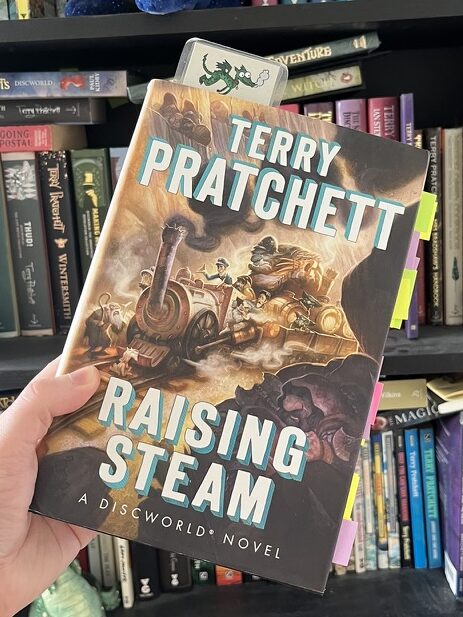
The cover of the first edition US hardcover, the first of Pratchett’s books to be published by Doubleday in the US. The cover art is by Justin Gerard, his only cover for a Discworld novel, though he did do the US covers for The Science of Discworld books, The Folklore of Discworld, A Blink of the Screen and A Slip of the Keyboard.

Notes and Errata

  • The episode title makes the obvious gag that Pratchett himself didn’t, combining ginnungagap – the primordial “yawning void” of Norse (and Discworld dwarfish) mythology, from which the world (or one of them, at least) was created – and “mind the gap”, the famous advice on posters and announcements in the London Underground, warning passengers of the gap between the train and the platform.
  • As mentioned, Craig was previously a guest on one of our last pre-pandemic episodes: #Pratchat27, “Leshp Miserablés”, discussing Jingo.
  • “Gunzel” is uniquely Australian slang for a train or tram spotter – or by analogy, anyone with a specific nerdy interest (though that usage is uncommon). While it has an uncertain etymology, the term is at least several decades old; one account traces it specifically back to employees of the Sydney Tramway Museum in the 1960s, who supposedly picked it up from The Maltese Falcon (as they enjoyed using exaggerated American slang from old films and magazines). Originally used as a insult akin to British terms like “gricer” and “anorak”.
  • Melbourne’s City Loop is a central underground railway system passing in a circle through five stations in Melbourne’s central business district (CBD). Until 2025, all major train lines in Melbourne entered the loop on one of four tracks, passing through all of these stations before exiting again. In order to relieve congestion – there are eleven different train lines, but only four tracks in the loop – a new Metro Tunnel project was commenced in 2015 to dig a new tunnel across the CBD, linking the southeast directly to the northwest and creating five new underground stations (some of which are connected directly to the existing ones) in Melbourne and its inner suburbs. Those stations and the new tunnel opened in November 2025, and eventually some of the train lines will stop running around the loop and only run through the tunnel. (While not a true gunzel, Ben is very keen on public transport, so unlike Liz he’s very much looking forward to travelling on the new train route and seeing the new stations.)
  • Rob Wilkins gives an account of the writing of Raising Steam in the final chapter of the official Pratchett biography, A Life with Footnotes. He described the process as quite different from the usual, with Pratchett producing many, many scenes, but never getting to the stage of finding the “unifying, crystallising vision that would have turned these scenes into a novel”. He credits Pratchett’s UK editor, Philippa Dickson, with finding the pattern and the gaps in those scenes, and giving Wilkins advice on where to guide Pratchett in order to turn them into a book. Notably not involved was Pratchett’s previous and just as talented and beloved US editor, Jennifer Brehl, as he had only recently switched US publishers from HarperCollins to Knopf Doubleday. (This explains the new cover artist, as seen on Ben’s edition.)
  • Train-based fantasy, sci-fi and other fiction that we mention include:
    • Perdido Street Station and its sequels The Scar and The Iron Council, weird fiction novels by China Miéville which combine elements of fantasy and steampunk. The Iron Council features trains most prominently of the three.
    • Iron Dragon, perhaps the first “crayon rails” style train board game set in a fantasy world.
    • Westworld, the television series (based on the 1973 film) about fantasy theme parks staffed by “Hosts”, artificially intelligent robots indistinguishable from humans. The titular “Westworld”, a wild west town, was serviced by a replica steam train, which later plays an important part in the plot.
    • Points and Lines, aka Tokyo Express in the newer 2022 English translation, a 1958 Japanese crime novel by Seichō Matsumoto involving trains and timetables.
    • The Dark Tower series of novels, specifically The Waste Lands and Wizard and Glass, by Stephen King. These books feature Blaine, an insane artificial intelligence which controls a monorail train. The children’s book which references Blaine is Charlie the Choo-Choo.
    • Deadlands is a roleplaying game originally designed by Shane Lacy Hensley. The supernatural ore that powers some of its steampunk technology is called “ghost rock”. The current version is a setting for the Savage Worlds roleplaying game, rather than a game in its own right. Note that like many “weird west” games and stories of the twentieth century, the original 1990s edition contained plenty of appropriation (and misrepresenation) of the cultures of Native and Black Americans; we’re not sure what the later versions are like.
    • Spire: The City Must Fall and Heart: The City Beneath, a pair of related tabletop roleplaying games designed by Grant Howitt and Chris Taylor. The class Ben mentions is the “Vermissian Knight”, though Ben got their ability twisted a bit; one of their “zenith abilities” (that are generally a character’s final act) turns them into a living train, who steams off into the Heart (the weird, living dungeon beneath the city of Spire, from which the abandoned Vermissian train system drew its power). The remaining members of their party get a special “Deus Ex Machina” abiltity that they can cash in once to have the train-thing return, smashing into an enemy who is defeating them and dealing massive damage before going on their way again.
    • The Peter Grant novels, particularly Whispers Underground, by Ben Aaronovitch. Aaronovitch is a big Pratchett fan, and references the Discworld in most of his novels; he also coincidientally reviewed Raising Steam for The Guardian when it was first published.
    • Snowpiercer, a film and subsequent television series, both based on the French graphic novel by Jacques Lob.
    • Abiotic Factor, a survival videogame by New Zealand developers Deep Field Games. The Train, also known as “the Steam Engine” or IS-0138 (a designation usually given to creatures or objects, rather than worlds), is noted as “highly dangerous” with the note “IT MUST NEVER STOP”.

More notes coming soon!

Thanks for reading our notes! If we missed anything, or you have questions, please let us know.
Posted in: Episode Notes Tagged: Adorabelle Dearheart, Ankh-Morpork, Ben McKenzie, Craig Hildebrand-Burke, Discworld, Elizabeth Flux, Moist von Lipwig, Nobby, Sam Vimes, The Watch, Vetinari

#Pratchat90 – Mind the Ginnungagap

8 December 2025 by Pratchat Imps Leave a Comment

Psychologist Craig Hildebrand-Burke rejoins Liz and Ben as we don our flat caps and anoraks, as we make sense of Terry Pratchett’s penultimate Discworld novel, 2013’s Raising Steam.

Dick Simnel has created Iron Girder, the Disc’s first steam engine – and he’s brought it to Ankh-Morpork seeking an investor. He finds one in Sir Harry King, who is keen to be known as the King of something other than what brought him his wealth. As excitement and interest in the “steam engines” starts to build, Lord Vetinari sees its potential – but only if someone oversees this new enterprise on behalf of the city. That someone is, of course, Moist von Lipwig, who is in need of a new way to live dangerously. And dangerous it will be, since the conservative dwarf grags are once again moving against their progressive King. They’re attacking anything too new to be traditionally dwarfish – which means modern dwarfs, clacks towers, goblins with jobs…and the steam train…

Terry Pratchett clearly had a love of steam engines – he particularly requested a steam roller be the thing to destroy his unfinished works after his death. This at least partly explains why – instead of the announced Raising Taxes – the next Moist von Lipwig book would see him helping to bring the Discworld into the age of steam. Written in 2012 and 2013, as Pratchett’s illness started to worsen, it had a troubled journey into existence, with Rob Wilkins writing in the official biography that ‘the real triumph of Raising Steam was that it existed at all.’ But while it might lack the sharpness of plot and theme and structure that mark Pratchett’s best work, there are still plenty of great jokes, characters, observations and ideas in Raising Steam – especially for the Discworld fan who’s also a bit of a gunzel (that’s Fourecksian for “train spotter”).

Have you read Raising Steam? How do you rate it, compared to the previous novels in the series? How many words did you have to look up? What were your favourite allusions to the history of steam, and to railway fiction, that we didn’t mention? Get aboard the comment train by using the hashtag #Pratchat90 on social media, or comment on our website, to join the conversation!

https://media.blubrry.com/pratchat/pratchatpodcast.com/episodes/Pratchat_episode_90.mp3

Podcast: Play in new window | Download (Duration: 2:24:21 — 66.6MB)

Subscribe: RSS | More

Guest Craig Hildebrand-Burke (he/him) is an educational and development psychologist who last joined us way back in January 2020 for #Pratchat27, “Leshp Miserablés”, to talk about Jingo. He specialises in working with neurodivergent children and young people and their families, as well as d/Deaf and hard of hearing children and families. We can’t advertise his actual practice, but you can find him on Instagram as @craighbpsychologist. (There are only a few posts in the grid, but he shares a lot of great stuff as reels!)

You can find episode notes and errata on our web site.

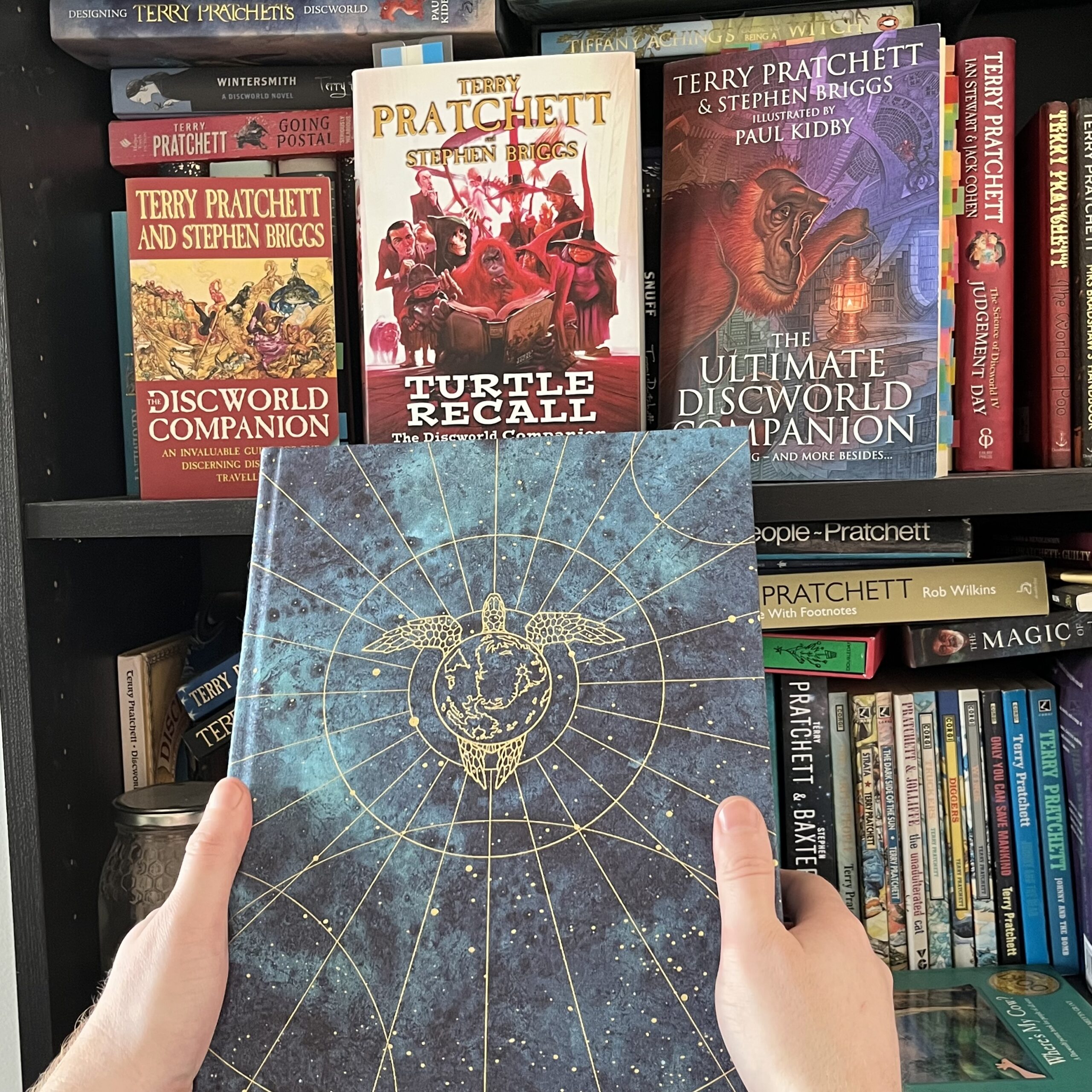
Now we’re nearly at the end of the Discworld, it’s time to make sense of it all – so next month, we’ll be sifting through the A-Z of the series, The Discworld Companion! (We’ll be using The Ultimate Discworld Companion as the default, but any version you have should do!) Send us any questions you have about this encyclopaedia-like tome via email (chat@pratchatpodcast.com), or send a clacks over your social network of choice using the hashtag #Pratchat91.

Want to help us get to the end of our six(ish) year mission and read every Pratchett book – and more? You can support us with a tip, or a subscription for as little as $2 a month, and that’s cuttin’ our own throats! See our Support Us page for details.

Posted in: Podcast Tagged: Adorabelle Dearheart, Ankh-Morpork, Ben McKenzie, Colon, computer game, Craig Hildebrand-Burke, Discworld, Dwarfs, Elizabeth Flux, goblins, Harry King, Moist von Lipwig, Nobby, Rincewind, Sam Vimes, Vetinari, Wizards

#Pratchat27 – Leshp Miserablés

8 January 2020 by Pratchat Imps 1 Comment

In episode 27, Liz and Ben are joined by guest writer and psychologist-in-training Craig Hildebrand-Burke to discuss Terry Pratchett’s depressingly relevant yet uplifting 1997 Discworld novel of war and prejudice, Jingo.

In the middle of the Circle Sea, halfway between Ankh-Morpork and Klatch, the ancient and slightly eldritch island of Leshp has risen from the waves. Of course both nations want to claim it as their own, what with the other nation being filthy foreign devils, and almost immediately the threat of war is in the wind. An attempt on the life of a visiting Klatchian prince kills peace talks before they can even begin, and the Patrician is deposed – leaving Sir Samuel Vimes, Lord Commander of the City Watch, with a crime to solve. Can bringing a murderer to justice stop a war?

Jingo sees the Watch swell in size, gives a great deal of airtime to the Patrician, and also shines the spotlight on the Disc’s greatest inventor, Leonard of Quirm! And of course we spend more time in Klatch, now inspired more by Lawrence of Arabia than Arabian Nights. It’s a story of nationalism, racism and war – both of the regular kind, and between the classes. Jingo was not only still relevant when we recorded this, but has suddenly and awfully become more relevant since. Can Pratchett help us do away with ideas of Us and Them? Can he flesh out the previously cartoony city/nation/continent of Klatch? And how great are submarines? Use the hashtag #Pratchat27 on social media to join the conversation!

https://media.blubrry.com/pratchat/pratchatpodcast.com/episodes/Pratchat_episode_27.mp3

Podcast: Play in new window | Download (Duration: 2:05:29 — 57.8MB)

Subscribe: RSS | More

Guest Craig Hildebrand-Burke is a writer who has recently completed a psychology degree. He’s written fiction, non-fiction, reviews and commentary for publications including Tincture, Writers Bloc, ACMI and SBS News. You can find him on Twitter as @_CraigHB.

Next month we leave the Discworld and head into outer space – and inside a computer – in 1992’s Only You Can Save Mankind, the first of the Johnny Maxwell books for middle grade readers. We’ll be recording in late January, so get your questions in via social media using the hashtag #Pratchat28.

You’ll find the full notes and errata for this episode on our web site.

We recorded before the current Australian bushfires reached their peak, and so barely mentioned them in the episode; if you’d like to help the firefighters, wildlife workers or those affected by the fires, this JJJ article has some good places to start.

Want to help us get to the end of our six(ish) year mission and read every Pratchett book – and more? You can support us with a tip, or a subscription for as little as $2 a month, and that’s cuttin’ our own throats! See our Support Us page for details.

Posted in: Podcast Tagged: Angua, Ankh-Morpork, Ben McKenzie, Carrot, Cheery Littlebottom, Colon, Craig Hildebrand-Burke, Detritus, Discworld, Dorfl, Elizabeth Flux, Klatch, Nobby, Patrician, Sybil, The Watch, Vimes

#Pratchat27 Notes and Errata

8 January 2020 by Ben Leave a Comment

Theses are the show notes and errata for episode 27, “Leshp Miserablés“, featuring guest Craig Hildebrand-Burke, discussing the 1997 Discworld novel Jingo.

  • The O.C. is a 1990s teen drama we’ve previously mentioned in #Pratchat23, “The Music of the Nitt“. It starred the other Ben McKenzie.
  • “Sometimes a cigar is just a cigar” – meaning there’s not a hidden meaning in everything, no matter how obvious the phallic imagery may seem – is a phrase often attributed to German psychoanalyst Sigmund Freud. It’s almost certain he never said it, though.
  • Cthulhu is the ancient, god-like being created by H. P. Lovecraft, giving the name “Cthulhu Mythos” to the universe of linked cosmic horror stories written by Lovecraft and others. They feature Cylcopean architecture with non-Euclidean angles, civilisations of horrific beings that pre-dated humans on Earth, and other elements of cosmic horror. We previously talked about Cthulhu in #Pratchat10, “We’re Gonna Need a Bigger Broomstick“, as Moving Pictures also features Cthulhu-like horrors. (Bel-Shahamroth, featured in The Colour of Magic, also draws inspiration from the works of Lovecraft, as well as earlier sword and sorcery writing.)
  • The tradition of a “Speaker’s Corner“, where anyone can stand on a soapbox and give their opinion, originates in Hyde Park London and dates back to at least the 19th century. The original Speaker’s Corner in Melbourne was at Birrarung Marr, on the banks of the Yarra River; it’s now held on the lawns outside the State Library and known as the Speaker’s Forum. Sydney’s Speaker’s Corner is at the Domain.
  • Blackadder Goes Forth was the fourth and final season of satirical historical comedy Blackadder created by Rowan Atkinson and Richard Curtis, though the later seasons were written by Curtis with Ben Elton. They star Atkinson as various members of the Blackadder family throughout history, always accompanied by his dogsbody (or general servant) Baldrick (played by Pratchett audiobook reader and star of Time Team, Toby Robinson). In Goes Forth, Edmund Blackadder is a Captain in the British Army on the Western Front of World War I. General Melchett (Stephen Fry) is their blustering Commanding Officer, who has no idea of their hardships and frequently orders them into danger from far behind the front.
  • You can find out more about the Mary Rose at the official web site.
  • The L-Space web was the primary web site hosting documents created on the newsgroup alt.fan.pratchett, including the Annotated Pratchett File (or APF). It still exists, though new annotations and notes now appear on the L-Space Wiki.
  • Pratchett spoke about “white knowledge” in several interviews, especially those given while publicising The Folklore of Discworld. He meant the phrase as an analogue to “white noise”, and defined it as knowledge you acquire without knowing how or where from.
  • Go Back to Where You Came From is an SBS reality television series which took groups of six Australians with “differing views” on asylum seekers and had them take the hazardous journey undertaken by refugees in reverse – sailing on small, seemingly fragile boats from Australia to nearby countries, and visiting refugee camps and other locations.
  • Tax avoidance is the (usually) legal avoidance of paying taxes, employed most successfully by the largest companies, who are allowed to offset profits with losses from previous years, depreciation of major assets (like fleets of airlines or electrical infrastructure), or income shifting (assigning income disproportionately to subsidiaries in countries with the lowest tax rates).
  • While the militarisation of police in the US is well-documented – many forces there have military-style assault rifles, some have tanks, and quite a few have been trained by ex-military forces personnel – it’s a more recent phenomenon here in Australia. After a year or so of discussion, Victoria Police announced in December 2019 it was buying 300 AR-15 assault rifles for use in “active armed offender” situations, though they have promised the guns will not be carried in public.
  • Terry Pratchett was awarded no fewer than ten honorary doctorates. They come mostly from universities in the United Kingdom, the first being from the University of Warwick in 1999. He also had one from Dublin University in 2008, and his last – awarded in May 2014, less than a year before his death – was from the University of South Australia. He was also an Adjunct Professor at the Universities of Dublin and South Australia, which more-or-less just meant he occasionally gave a guest lecture.
  • Andy Serkis is an English actor who rose to fame through his motion capture performance as Gollum in Peter Jackson’s film adaptation of The Lord of the Rings. He has since established himself as a influential voice in motion capture, both as an actor and director.
  • In the 2006 television adaptation of Hogfather, Nobby was played by Nicholas Tennant, who also played the Head Librarian in part one of the adaptation of The Colour of Magic.
  • The honorific “effendi” began life as a title in the Ottoman Empire, roughly equivalent to “sir”; it was derived from the Ancient Greek word authentēs, which means “lord”. It is still in use as an honorific in Egypt, Jordan and Turkey, though it’s not quite used the way it is presented in most Western fiction.
  • The attempt on Prince Khufurah’s life has many parallels with the assassination of JFK: he is in a procession along a route lined by onlookers; the shooter was in a tall building thought to be empty; there is a second shooter elsewhere (in our world behind a grassy knoll, rather than a gnoll); and the idea that the first gunman could have shot JFK in the manner that killed him is sometimes mocked by conspiracy theorists claiming that it would require “a magic bullet”. The initial investigation determined that Lee Harvey Oswald – himself murdered while in police custody – was working alone; a later investigation determined that there was indeed a second shooter, though it agreed that Oswald’s bullet was the one that killed the President.
  • The “Zapruder film” is the most famous footage of the assassination of President Kennedy. It was filmed by local clothing manufacturer Abraham Zapruder on a home-movie camera; he developed three copies of his film and gave two to the US Secret Service, and it was used in both major investigations of the assassination.
  • Leonardo Da Vinci secured the patronage of Ludovico Sforza, Duke of Milan, in around 1482, and was commissioned to build a huge bronze statue of a horse. A full-size clay model was made and exhibited to much acclaim, but the 80 tons of bronze intended for the statue was instead used to build cannons for a war against the French, and the statue was never completed. After the seizure of Milan by Louis XII, the clay model was used for target practice by French troops and destroyed. Some accounts say the Duke was impressed with Leonardo’s ingenuity and hired him to design weaponry, which may explain why his notebooks include many things that are definitely weapons, including a huge crossbow, guns with multiple barrels and armoured vehicles (including one with scythes to cut down enemy troops, illustrated complete with victims of the blades).
  • Hachikō was an Akita dog whose master, Hidesaburō Ueno, was a professor at the University of Tokyo. Ueno lived in Shibuya and Hachikō would come to Shibuya train station every day to meet him on his way home. Uneo died while at work in May 1925, but Hachikō continued visiting the station hoping to meet his master every day until his own death nearly ten years later. Hachikō became famous in 1932 when a newspaper wrote an article about him, and a statue was erected in his honour in 1934. The original statue was recycled during World War II, but a new statue by the original sculptor’s son was erected outside Shibuya Station in 1948. It’s still there, and the nearest entrance is now named after Hachikō. There are similar statues in Hachikō’s hometown Ōdate at the train station and the Akita Museum. In 2015, 80 years after his death, a new statue of Ueno meeting an excited Hachikō was unveiled at the University of Tokyo.
  • The film Lawrence of Arabia follows the exploits of real-life British officer T. E. Lawrence, who during World War I was sent to find out if the Syrian Prince Faisal had any chance of aiding in the war against Turkey. The film has been a source of controversy over its perceived historical inaccuracies, though it won many awards and propelled its star, Peter O’Toole, to great fame.
  • Embassies – the permanent homes of major “diplomatic missions” to other states – are not generally considered “foreign soil”, or “extra-territorial”, but fall under the jurisdiction of local governments. But they do get a bunch of privileges under the Vienna Convention on Diplomatic Relations established in 1961 which includes exemption from many local laws. And it turns out to be true that citizens and authorities of the local country cannot enter without permission – even to put out a fire!
  • Heartbeat was a British police drama which ran for 18 years between 1992 and 2010, based on the “Constable” novels by Nicholas Rhea (a pseudonym for ex-cop Peter N Walker). It was set in mid to late 1960s in fictional Yorkshire village of Aidensfield. It originally centred around PC Nick Rowan (Nick Berry) and his wife, Dr Kate Rowan (Niamh Cusack), but after a few years both left the program and characters took the limelight. The only characters to remain throughout were Yes Minister’s Derek Fowlds as Nick’s Sergeant, Blaketon, who later retires and takes over the local pub, and older fellow PC Alf Ventriss (William Simons), who was a commando in World War II and whose wife was mentioned frequently but never appeared on screen. We never even find out her first name!
  • There are many examples of the “battle butler” in fiction. Aside from Willikins, there’s Alfred Pennyworth (Batman), Jarvis (The Avengers comics), Oddjob (Goldfinger), Cadbury (Richie Rich, especially in the film), Kato (The Green Hornet) and Mr Butler (Artemis Fowl).
  • The “white saviour” narrative is a common trope, especially in film, where a white protagonist saves non-white people from disaster or war, usually by leading them or making them “more civilised”. Lawrence of Arabia is one of the earliest major examples, but there are many, many others.
  • The Watchmen television series, which was first released in 2019, serves as a sequel to the 1987 comic book series Watchmen by Alan Moore and Dave Gibbons. The comic is celebrated as a deconstruction of the superhero genre, and features a number of second-generation costumed vigilantes investigating a global conspiracy that seems to mean them harm. The television series, whose show runner is Damon Lindelof of Lost and The Leftovers fame, is set 34 years after the events of the original comics.
  • 20,000 Leagues Under the Sea is an 1870 novel by French author Jules Verne. It follows marine biologist Pierre Arronax and his companions Conseil and Ned as they investigate a mysterious sea creature which is attacking and sinking ships. The creature turns out to be the Nautilus, a miraculous and hyper-advanced submarine invented and commanded by the mysterious Captain Nemo. The story is great, but Ben recommends you stick to adaptations as the book is “approximately 50% lists of fish Arronax sees out the window”.
  • The only major appearances of the nation of Klatch are in Sourcery and Jingo, but other nations of the Klatchian continent make major appearances in Pyramids (Djelibeybi and Ephebe), Eric (Tsort and the Tezuman Empire) and Small Gods (Omnia and Ephebe). Various others, including Howondaland, crop up in references throughout the books.
  • The Crown is a 2016 Netflix series chronicling the history of Queen Elizabeth II of England, beginning with her marriage to Prince Philip, Duke of Edinburgh. Each season covers a different period of her reign, and so the main characters change and are re-cast over time. Elizabeth has so far been played by Claire Foy and Olivia Colman. The fourth season, coming in 2020, will bring the narrative through to the 1980s.
  • The “trousers of time” were actually first mentioned in Guards! Guards!. Inspiration for the phrase seems to have come from the 1960s radio sketch comedy I’m Sorry I’ll Read That Again, which featured a parody of Doctor Who titled “Professor Prune and the Electric Time Trousers”. The band Bangers has a track named “Trousers of Time” on their album Bird, which it seems must be a Discworld reference, since the first line is “I feel like I woke up in the wrong leg / Of the trousers of time”. “Trousers of Time” are also an item available in the videogame The Legend of Zelda: Breath of the Wild; the wording may be a Pratchett reference, but it’s more directly based on a previous game in the series, Ocarina of Time.
  • The dis-organiser is an astonishingly accurate prediction of modern smartphones’ “Intelligent Assistants“, which interpret spoken commands and automate tasks. One of those is “predictive appointments”, in which they suggest appointments for your calendar based on the content of your emails and other clues.
  • “Shaddap You Face” was a single by Italian-American-Australian performer Joe Dolce. Released in 1980, the song is about a young Italian migrant living in Melbourne, and is based on the language used by Dolce’s Italian grandparents. The chorus is the character’s mother telling him to cheer up, since “things are not so bad”. It was a number one hit in Australia, New Zealand, the UK and several European countries – though not, it should be noted, in Italy.
  • The Discworld Tacticus is probably based on several Roundworld people: his name comes from two Greek military writers, Aeneas Tacticus (4th century BCE) and Aelianus Tacitus (2nd century BCE), but also likely references Publius Cornelius Tacitus, a Roman historian from around the second century CE whose work is used extensively to teach Latin in schools. Tacticus’ advice on war seems more inspired by Sun Tzu, Chinese author of The Art of War from around the 6th century BCE.
  • For more on the names and genius of camels, see Pyramids.
  • Archduke Franz Ferdinand of Austria was famously assassinated in Sarajevo on the 28th of June, 1914. He was shot by Gavrilo Princip, a 19-year-old assassin armed by the Black Hand, a group of Serbian nationalists (Bosnia and Herzegovina was at the time part of the Austro-Hungarian empire). This lead to hostilities between Austria and Serbia and eventually to World War I.
  • We note that while The Joye of Snackes certainly represents one kind of danger of magical knowledge passing into print, it was likely printed using engraved plates, as movable type doesn’t properly come to Ankh-Morpork until The Truth.
  • We previously tried to cast Lady Sybil in episode 7A, “The Curious Incident of the Dragon and the Night Watch“.
  • Miranda Hart is an English comedian and actor best known for her BBC sitcom Miranda and medical drama Call the Midwife. You might also know her from Hyperdrive, Not Going Out and various other British film and television comedies. She’ll next be seen playing Miss Bates in a new feature film adaptation of Jane Austen’s Emma, directed by Autumn de Wilde.
Posted in: Episode Notes Tagged: Angua, Ankh-Morpork, Ben McKenzie, Carrot, Cheery Littlebottom, Colon, Craig Hildebrand-Burke, Detritus, Discworld, Dorfl, Elizabeth Flux, Klatch, Nobby, Patrician, Sybil, The Watch, Vimes

Follow Pratchat

Apple PodcastsSpotifyPodchaserPodcast IndexYoutube MusicRSSMore Subscribe Options
  • Bluesky
  • Mastodon
  • Instagram
  • YouTube
  • Facebook
  • Twitter

Latest episode:

  • Pratchat90 - Mind the Ginnungagap
    #Pratchat90 – Mind the Ginnungagap

Next time…

#Pratchat91 - The Discworld Companion8 January 2026
24 days to go.

We’re on Podchaser!

Podchaser - Pratchat

Meta

  • Log in
  • Entries feed
  • Comments feed
  • WordPress.org
Privacy & Cookies: This site uses cookies. By continuing to use this website, you agree to their use.

To find out more, including how to control cookies, see here: Cookie Policy

Copyright © 2025 Pratchat.

Pratchat WordPress Theme by Ben McKenzie


Loading Comments...