Pratchat
  • Home
  • News
  • Episodes
  • The Books
  • More!
    • Reading Challenge
    • The Guild of Recappers & Podcasters
  • Support Us
  • About

Sam Vimes

#Pratchat90 Notes and Errata

8 December 2025 by Ben Leave a Comment

These are the episode notes and errata for Pratchat episode 90, “Mind the Ginnungagap”, discussing the 40th Discworld novel, 2013’s Raising Steam, with returning guest Craig Hildebrand-Burke.

Iconographic Evidence

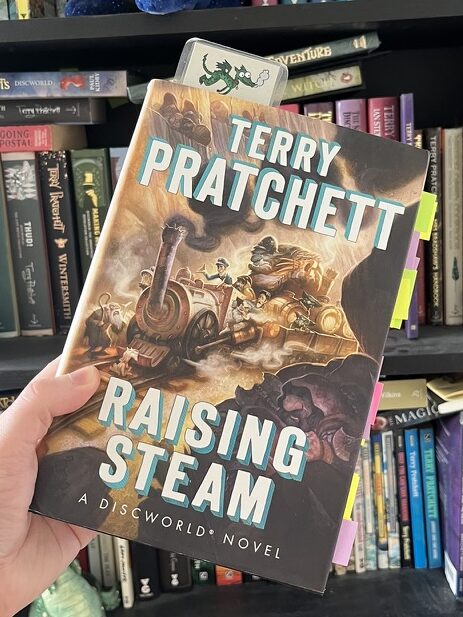
The cover of the first edition US hardcover, the first of Pratchett’s books to be published by Doubleday in the US. The cover art is by Justin Gerard, his only cover for a Discworld novel, though he did do the US covers for The Science of Discworld books, The Folklore of Discworld, A Blink of the Screen and A Slip of the Keyboard.

Notes and Errata

  • The episode title makes the obvious gag that Pratchett himself didn’t, combining ginnungagap – the primordial “yawning void” of Norse (and Discworld dwarfish) mythology, from which the world (or one of them, at least) was created – and “mind the gap”, the famous advice on posters and announcements in the London Underground, warning passengers of the gap between the train and the platform.
  • As mentioned, Craig was previously a guest on one of our last pre-pandemic episodes: #Pratchat27, “Leshp Miserablés”, discussing Jingo.
  • “Gunzel” is uniquely Australian slang for a train or tram spotter – or by analogy, anyone with a specific nerdy interest (though that usage is uncommon). While it has an uncertain etymology, the term is at least several decades old; one account traces it specifically back to employees of the Sydney Tramway Museum in the 1960s, who supposedly picked it up from The Maltese Falcon (as they enjoyed using exaggerated American slang from old films and magazines). Originally used as a insult akin to British terms like “gricer” and “anorak”.
  • Melbourne’s City Loop is a central underground railway system passing in a circle through five stations in Melbourne’s central business district (CBD). Until 2025, all major train lines in Melbourne entered the loop on one of four tracks, passing through all of these stations before exiting again. In order to relieve congestion – there are eleven different train lines, but only four tracks in the loop – a new Metro Tunnel project was commenced in 2015 to dig a new tunnel across the CBD, linking the southeast directly to the northwest and creating five new underground stations (some of which are connected directly to the existing ones) in Melbourne and its inner suburbs. Those stations and the new tunnel opened in November 2025, and eventually some of the train lines will stop running around the loop and only run through the tunnel. (While not a true gunzel, Ben is very keen on public transport, so unlike Liz he’s very much looking forward to travelling on the new train route and seeing the new stations.)
  • Rob Wilkins gives an account of the writing of Raising Steam in the final chapter of the official Pratchett biography, A Life with Footnotes. He described the process as quite different from the usual, with Pratchett producing many, many scenes, but never getting to the stage of finding the “unifying, crystallising vision that would have turned these scenes into a novel”. He credits Pratchett’s UK editor, Philippa Dickson, with finding the pattern and the gaps in those scenes, and giving Wilkins advice on where to guide Pratchett in order to turn them into a book. Notably not involved was Pratchett’s previous and just as talented and beloved US editor, Jennifer Brehl, as he had only recently switched US publishers from HarperCollins to Knopf Doubleday. (This explains the new cover artist, as seen on Ben’s edition.)
  • Train-based fantasy, sci-fi and other fiction that we mention include:
    • Perdido Street Station and its sequels The Scar and The Iron Council, weird fiction novels by China Miéville which combine elements of fantasy and steampunk. The Iron Council features trains most prominently of the three.
    • Iron Dragon, perhaps the first “crayon rails” style train board game set in a fantasy world.
    • Westworld, the television series (based on the 1973 film) about fantasy theme parks staffed by “Hosts”, artificially intelligent robots indistinguishable from humans. The titular “Westworld”, a wild west town, was serviced by a replica steam train, which later plays an important part in the plot.
    • Points and Lines, aka Tokyo Express in the newer 2022 English translation, a 1958 Japanese crime novel by Seichō Matsumoto involving trains and timetables.
    • The Dark Tower series of novels, specifically The Waste Lands and Wizard and Glass, by Stephen King. These books feature Blaine, an insane artificial intelligence which controls a monorail train. The children’s book which references Blaine is Charlie the Choo-Choo.
    • Deadlands is a roleplaying game originally designed by Shane Lacy Hensley. The supernatural ore that powers some of its steampunk technology is called “ghost rock”. The current version is a setting for the Savage Worlds roleplaying game, rather than a game in its own right. Note that like many “weird west” games and stories of the twentieth century, the original 1990s edition contained plenty of appropriation (and misrepresenation) of the cultures of Native and Black Americans; we’re not sure what the later versions are like.
    • Spire: The City Must Fall and Heart: The City Beneath, a pair of related tabletop roleplaying games designed by Grant Howitt and Chris Taylor. The class Ben mentions is the “Vermissian Knight”, though Ben got their ability twisted a bit; one of their “zenith abilities” (that are generally a character’s final act) turns them into a living train, who steams off into the Heart (the weird, living dungeon beneath the city of Spire, from which the abandoned Vermissian train system drew its power). The remaining members of their party get a special “Deus Ex Machina” abiltity that they can cash in once to have the train-thing return, smashing into an enemy who is defeating them and dealing massive damage before going on their way again.
    • The Peter Grant novels, particularly Whispers Underground, by Ben Aaronovitch. Aaronovitch is a big Pratchett fan, and references the Discworld in most of his novels; he also coincidientally reviewed Raising Steam for The Guardian when it was first published.
    • Snowpiercer, a film and subsequent television series, both based on the French graphic novel by Jacques Lob.
    • Abiotic Factor, a survival videogame by New Zealand developers Deep Field Games. The Train, also known as “the Steam Engine” or IS-0138 (a designation usually given to creatures or objects, rather than worlds), is noted as “highly dangerous” with the note “IT MUST NEVER STOP”.

More notes coming soon!

Thanks for reading our notes! If we missed anything, or you have questions, please let us know.
Posted in: Episode Notes Tagged: Adorabelle Dearheart, Ankh-Morpork, Ben McKenzie, Craig Hildebrand-Burke, Discworld, Elizabeth Flux, Moist von Lipwig, Nobby, Sam Vimes, The Watch, Vetinari

#Pratchat90 – Mind the Ginnungagap

8 December 2025 by Pratchat Imps Leave a Comment

Psychologist Craig Hildebrand-Burke rejoins Liz and Ben as we don our flat caps and anoraks, as we make sense of Terry Pratchett’s penultimate Discworld novel, 2013’s Raising Steam.

Dick Simnel has created Iron Girder, the Disc’s first steam engine – and he’s brought it to Ankh-Morpork seeking an investor. He finds one in Sir Harry King, who is keen to be known as the King of something other than what brought him his wealth. As excitement and interest in the “steam engines” starts to build, Lord Vetinari sees its potential – but only if someone oversees this new enterprise on behalf of the city. That someone is, of course, Moist von Lipwig, who is in need of a new way to live dangerously. And dangerous it will be, since the conservative dwarf grags are once again moving against their progressive King. They’re attacking anything too new to be traditionally dwarfish – which means modern dwarfs, clacks towers, goblins with jobs…and the steam train…

Terry Pratchett clearly had a love of steam engines – he particularly requested a steam roller be the thing to destroy his unfinished works after his death. This at least partly explains why – instead of the announced Raising Taxes – the next Moist von Lipwig book would see him helping to bring the Discworld into the age of steam. Written in 2012 and 2013, as Pratchett’s illness started to worsen, it had a troubled journey into existence, with Rob Wilkins writing in the official biography that ‘the real triumph of Raising Steam was that it existed at all.’ But while it might lack the sharpness of plot and theme and structure that mark Pratchett’s best work, there are still plenty of great jokes, characters, observations and ideas in Raising Steam – especially for the Discworld fan who’s also a bit of a gunzel (that’s Fourecksian for “train spotter”).

Have you read Raising Steam? How do you rate it, compared to the previous novels in the series? How many words did you have to look up? What were your favourite allusions to the history of steam, and to railway fiction, that we didn’t mention? Get aboard the comment train by using the hashtag #Pratchat90 on social media, or comment on our website, to join the conversation!

https://media.blubrry.com/pratchat/pratchatpodcast.com/episodes/Pratchat_episode_90.mp3

Podcast: Play in new window | Download (Duration: 2:24:21 — 66.6MB)

Subscribe: RSS | More

Guest Craig Hildebrand-Burke (he/him) is an educational and development psychologist who last joined us way back in January 2020 for #Pratchat27, “Leshp Miserablés”, to talk about Jingo. He specialises in working with neurodivergent children and young people and their families, as well as d/Deaf and hard of hearing children and families. We can’t advertise his actual practice, but you can find him on Instagram as @craighbpsychologist. (There are only a few posts in the grid, but he shares a lot of great stuff as reels!)

You can find episode notes and errata on our web site.

Now we’re nearly at the end of the Discworld, it’s time to make sense of it all – so next month, we’ll be sifting through the A-Z of the series, The Discworld Companion! (We’ll be using The Ultimate Discworld Companion as the default, but any version you have should do!) Send us any questions you have about this encyclopaedia-like tome via email (chat@pratchatpodcast.com), or send a clacks over your social network of choice using the hashtag #Pratchat91.

Want to help us get to the end of our six(ish) year mission and read every Pratchett book – and more? You can support us with a tip, or a subscription for as little as $2 a month, and that’s cuttin’ our own throats! See our Support Us page for details.

Posted in: Podcast Tagged: Adorabelle Dearheart, Ankh-Morpork, Ben McKenzie, Colon, computer game, Craig Hildebrand-Burke, Discworld, Dwarfs, Elizabeth Flux, goblins, Harry King, Moist von Lipwig, Nobby, Rincewind, Sam Vimes, Vetinari, Wizards

#Pratchat80 – Always Believe in Your Golems

8 October 2024 by Pratchat Imps 2 Comments

Inequality reporter Stephanie Convery returns on a trip with Liz and Ben into the world of banking, high finance and monetary theory in Terry Pratchett’s thirty-sixth Discworld novel, 2007’s Making Money.

The Ankh-Morpork Post Office is running very smoothly – which has left Moist von Lipwig, reformed con-man and Postmaster General, at a loose end. But he resists the Patrician’s offer of a new job revitalising the Royal Mint and Royal Bank of Ankh-Morpork. The bank’s current owner is a Mark 1 Feisty Old Lady who knows her rich family are out to get her – and her little dog, too. But despite Moist’s best attempts to not get involved, both dog and bank wind up in his care – putting him in the sights of the Lavish family, and especially Vetinari-obsessed Cosmo Lavish. Meanwhile, manager of the Golem Trust (and Moist’s fiancée) Adora Belle Dearheart is digging up something ancient out on the desert. And Moist’s past is about to catch up with him…

Just a few novels after debuting in Going Postal, Moist von Lipwig is back! Making Money is about the nature of money, but also about the thrill of the chase, grappling with one’s inner nature, and obsession. Aside from Gladys the Golem, Moist and Adora Belle bring few of their previous supporting cast along for the ride; instead we meet a new cast including Mr Bent, the Lavishes, another Igor, the Post-Mortem Communications Department of Unseen University, and the very good boy Mr Fusspot.

Does this live up to the promise of Going Postal? Could Moist be in other Discworld books in disguise – and if so, as who? Did you guess Mr Bent’s secret? And if you had a Glooper, what would you use it to change in the world of money? No purchase necessary to join the conversation for this episode; just email us or use the hashtag #Pratchat80 on social media.

https://media.blubrry.com/pratchat/pratchatpodcast.com/episodes/Pratchat_episode_80.mp3

Podcast: Play in new window | Download (Duration: 2:39:14 — 73.5MB)

Subscribe: RSS | More

Stephanie Convery (she/her) is is a writer and author. Previously the Deputy Culture Editor for The Guardian Australia, she’s now their dedicated inequality reporter. Stephanie’s first book, After the Count: The Death of Davey Browne, was published in March 2020 by Penguin Books. (We suspect it won’t be her last.) You can follow Stephanie on Twitter at @gingerandhoney, and find her work at Guardian Australia. Her previous appearances on Pratchat were for #Pratchat2, “Murdering a Curry” (about Mort), and #Pratchat42, “Truth, the Printing Press, and Every -ing” (about The Truth).

You’ll find full notes and errata for this episode on our website.

Next episode we’re continuing our Moist streak (sorry) with the (so far) latest Discworld board game: Clacks! If you have questions about this game recreating the race between Moist and the Grand Trunk company, get them in to us by mid-October 2024 by tagging us or using the hashtag #Pratchat81 on social media, or emailing us at chat@pratchatpodcast.com.

Want to help us get to the end of our six(ish) year mission and read every Pratchett book – and more? You can support us with a tip, or a subscription for as little as $2 a month, and that’s cuttin’ our own throats! See our Support Us page for details.

Posted in: Podcast Tagged: Adorabelle Dearheart, Ankh-Morpork, Ben McKenzie, Discworld, Elizabeth Flux, Gladys, Igor, Moist von Lipwig, Patrician, Sam Vimes

#Pratchat76 Notes and Errata

8 April 2024 by Ben Leave a Comment

These are the episode notes and errata for Pratchat episode 76, “Real Men Don’t Drink…Decaf”, discussing the 2003 standalone Discworld novel Monstrous Regiment with guest Freya Daly Sadgrove.

Iconographic Evidence

Here’s “how is prangent formed”, the most famous YouTube compilation of misspelled Yahoo Answers questions about being pregnant, from 21 October 2016. While it’s mostly a bit of fun, it’s important to remember these were all asked by real people who had real fears and worries, just no way to edit their hastily (and perhaps secretly) typed questions. The US has a lot to answer for when it comes to sex (and indeed general) education…

Here’s that Traffic Accident Commission ad we mentioned, but please be warned, it’s pretty intense (though not gory).

Notes and Errata

  • The episode title is a bit of a mash-up of two ideas: first, Real Men Don’t Eat Quiche, the 1982 book by Bruce Feirstein satirising American ideas of masculinity (and which we last mentioned in our episode about The Unadulterated Cat, “The Cat in the Prat”). The second is another riff on the classic vampire line “I don’t drink…wine”, originally from the 1931 film Dracula starring Bela Lugosi (though the original line was “I never drink…wine”). Just to be clear: we don’t think there’s anything wrong with drinking decaf, or believe in the idea of a “real man”. You’re a man if you think you are; that’s how gender works.
  • “Let’s Get Down to Business” is the first line of the song “I’ll Make a Man Out of You” from the 1998 Disney animated film Mulan. Mulan is an adaptation of a Chinese folk story from around the 4th to 6th centuries BCE about Hua Mulan, a young woman who disguises herself as a man to fulfil her family’s conscription obligations, saving her father from being forced to join the army. She goes on to win great battles and achieve great fame. In the film, “I’ll Make a Man Out of You” is sung by Mulan’s Captain, Li Shang (played by BD Wong, but sung by Donny Osmond!), during a training montage for Mulan and her fellow fresh recruits.
  • Diana Wynne Jones (1934-2011) was a British fantasy children’s author. As one of Liz’s other favourite authors, we’ve mentioned her a lot – and one of these days we’ll do an episode or more about her books. Her most famous works include the Chrestomanci series about magical parallel universes, and Howl’s Moving Castle. The titular Howl is a mighty wizard, but the protagonist of the story is Sophie, the eldest daughter of a hat shop owner, who is cursed with old age by the Witch of the Wastes. Sophie gets a job as a cleaner for the wizard Howl, and makes a bargain with his fire demon, Calcifer, that he will restore her youth if she can free him from his contract to the wizard. It was very succesfully (if very loosely) adapted into a film by Hayao Miyazaki for Studio Ghibli in 2004.
  • The panel featuring Terry Pratchett and Diana Wynne Jones was “Whose Fantasy” at the Institute of Contemporary Arts in 1988. (Ben found it after we wondered if the two were friends in #Pratchat46, “The Helen Green Preservation Society”, and we mentioned it more recently in #Pratchat72, “The Masked Dancer”). It was chaired by Neil Gaiman and also features John Harrison and Geoff Ryman.
  • You can read the full text of the Daily Express review of Monstrous Regiment on Colin Smythe’s web page for the book. It opens with: “Not so long ago in a pub far, far, away Terry Pratchett announced that he had discovered an interesting fact. In the American Civil War more than 300 women had enlisted in the army dressed as men. There may have been more. These were just one ones who told people about it afterwards.”
  • Questionable Content (QC for short) is a long-running webcomic written and illustrated by American-Canadian cartoonist Jeph Jacques. It started in 2003, and is a slice-of-life story about indie rock fan Martin Reed and friends, set in a slightly futuristic world where artificial intelligence and advanced cybernetics are commonplace. At the time of writing it’s had more than 5,200 instalments! Elliot is a character introduced in 2011, an employee at a bakery first visited by Martin in Comic 1,845. Like Paul Perks, he’s a big but gentle man.
  • We previously met the small-but-officious Nuggan in the “illustrated Discworld fable” The Last Hero, as discussed in #Pratchat55, “Mr Doodle, the Man on the Moon”.
  • For the curious, you can find a list of Abominations Unto Nuggan mentioned in this book (and elsewhere – mainly The Last Hero and The Compleat Discworld Atlas) at the L-Space Wiki.
  • For reference, the members of the Monstrous Regiment are:
    • Lieutenant Blouse (no first name given; later promoted to much higher rank)
    • Sergeant Jack Jackrum (no other name given; later promoted to Sergeant Major)
    • Corporal Strappi (later revealed to (probably?) be a Captain and a “political”)
    • Private Oliver “Ozzer” Perks (Polly; later promoted to Sergeant)
    • Private Maladicta (Maladict)
    • Private Carborundum (Jade)
    • Private Igor (Igorina)
    • Private “Tonker” Halter (Magda)
    • Private “Shufti” Manickle (Betty)
    • Private “Wazzer” Goom (Alice)
    • Private “Lofty” Tewt (Tilda)
  • Ben gives a short account of The First Blast of the Trumpet Against the Monstruous Regiment of Women in the footnote, but if you want to read it, the full text is available via Project Goodmountain – er, Gutenberg.
  • We first heard about Terry Pratchett’s 2014 interview at the Wheeler Centre during the recording of #Pratchat26, “The Long Dark Mr Teatime of the Soul“ – our guest, Michael Williams, was director of the Centre at the time, and was the interviewer for the event. His story about making a faux pas – and Terry’s reaction – are included in the third episode of our subscriber bonus podcast, Ook Club. The full discussion, titled “Imagination, Not Intelligence, Made Us Human”, is available via YouTube. There’s a lot of good stuff in it! Pratchett mentions researching the history of women fighting and living as men at “a nice little place in London run by ladies who like other ladies very much indeed”; this is around the 31:30 mark.
  • “Sweet Polly Oliver” (also known as “Pretty Polly Oliver”) is song #367 in the Roud folk song index. It comes from around 1840 or earlier, and the first lines are “As sweet Polly Oliver lay musing in bed / A sudden strange fancy came into her head.” As Liz mentions, in the song Polly is following her lover, whom she eventually finds promoted to Captain and wounded; the doctors give up on him, but she nurses him back to health and they get married.
  • There are many other references to real protest and folk songs in the book; here are some of the folk songs:
    • “The World Turned Upside Down” – a British protest song from the 1640s, railing against restrictions placed on the celebration of Christmas by the British Parliament. A long-standing but unlikely story is that it was played by the British army band when Lord Cornwallis surrendered to the Americans after the Battle of Yorktown, hence the Hamilton song “Yorktown (The World Turned Upside Down)”. (Usually the band would play a song from the victor’s nation, but supposedly George Washington refused this tradition and told them to play a British song.)
    • “The Devil Shall Be My Sergeant” – a reference to “The Rogue’s March”, a song which was once traditionally played when drumming a disgraced solider out of the army. It had various sets of unofficial lyrics, many of which included the line “the Divil shall be me sergeant”. When it was no longer used officially by armies, it was played as “rough music” – yes, that was a thing on Roundworld, both in a similar sense as in I Shall Wear Midnight (see #Pratchat66, “Ol’ No Eyes is Back”), and more literally as a tune to shame followers of unpopular causes.
    • “Johnny Has Gone for a Solider” – an Irish folk song popular during the American Revolutionary War.
    • “The Girl I Left Behind Me” – Roud index #262, also known as “The Girl I Left Behind”. This is an English folk song from Elizabethan times, traditionally sung when soldiers marched off to war or a naval vessel set sail. It’s also the source of the lyric “Her golden hair in ringlets fair” which Igor quotes when coming up with excuses for Polly to have her old hair in her bag.
    • “Lisbon” or “William and Nancy” or “William and Polly” – #551 in the Roud index, this is possibly the song that Jackrum mentions when explaining the “Cheesemongers” nickname, which begins with the line “’Twas on a Monday morning, all in the month of May”. It’s sung by a sailor, William, who’s about to sail for Lisbon, and is leaving his pregnant lover, Nancy or Polly, behind. Nancy writes back to him saying she’ll disguise herself as a man so she can sail with him and save him from the terrors of the navy. The rest of the song doesn’t really match Jackrum’s description, which mashes up a whole lot of different bawdy folk tunes. There’s also “Dashing Away With the Smoothing Iron”, #869 in the Roud index, which begins with the first half of the line; it’s about a man repeatedly admiring a woman while she’s doing her ironing, and was the inspiration for Flanders and Swann’s “The Gas-Man Cometh”.
  • We read The Last Continent way back in 2020 in #Pratchat29, “Great Rimward Land”. The Last Continent is the twenty-second Discworld book, published in 1998, nine books and four years and four months before Monstrous Regiment. (Pratchett was still publishing two books a year at the time.)
  • Traditionally, tailors do indeed ask if gentlemen “dress to the left or right”, but stories conflict over whether this is because they intend to make said gentleman’s trousers more roomy on that side, or whether they just ask to avoid any awkward moments while taking inside leg measurements.
  • There have been many Roundworld equivalents of the Nugganite Working Girl Schools; some of the most infamous were the Magdalene Laundries run by the Catholic Church in Ireland. These were filled with so-called “fallen women” – mostly, but not exclusively, sex workers and pregnant girls – who were forced to work for free and suffered abuse at the hands of the staff.
  • Indulgences are a practice of the Catholic church. Ben is referring to “full indulgence”, a complete forgiveness for all sins offered to Crusaders, but regular indulgences are the reason for the minor penances of saying a number of “Hail Mary”s in order to be forgiven for sins confessed. When they were introduced the idea was that previous Catholics had lived such perfect lives that there’s a “treasury of merit” within the church, allowing them to give out lesser penances than the older, much harsher ones.
  • Ogres having layers is a reference to the 2001 DreamWorks animated film Shrek, in which the titular ogre (played by Mike Myers with a Scottish accent) explains to a talking Donkey (played by Eddie Murphy) that he’s not just the awful smelly monster that everyone assumes: “Ogres are like onions. They have layers. You peel them back and you find something else.” The film is (very loosely) based on a 1990 picture book by William Steig.
  • Maladict’s hallucinations make many general references to the tropes of Vietnam War films, but the main specific one we could spot was from Stanley Kubrick’s Full Metal Jacket (1987). In the film, the character Joker (played by Matthew Modine) writes “BORN TO KILL” on his hat, which matches the undead Maladict’s “BORN TO DIE”.
  • Matchbox Twenty are an American rock band from Orlando, Florida, fronted by singer and keyboard player Rob Thomas. Their debut 1996 post-grunge album Yourself or Somebody Like You was a massive hit, including the song “Push”, most recently seen being sung by various versions of Ken in the 2023 movie Barbie.
  • Blink-182 are a Californian rock band formed in 1992 whose third album, Enema of the State (1999), was probably their biggest success, with the singles “What’s My Age Again?” and “All the Small Things” doing well in many English-speaking countries at the time.
  • We last spoke of Danger 5 in #Pratchat52, “A Near-Watch Experience”. Created for SBS in 2012, Danger 5 is an action-comedy from the Australian comedy team Dinosaur. The first season is a parody of old school “men’s adventure” magazines and TV shows, with the titular “Danger 5” team repeatedly thwarting (though failing to capture or kill) Adolf Hitler in an absurd 1960s version of World War II. The second season from 2015 moves the team, Hitler and the target of their parody into the 1980s. You might still find it on Blu-Ray or DVD if you’re lucky; it was released by Madman Entertainment, but isn’t widely available. It was on Netflix in several territories for a while, but not any more; you can at least find clips, cast commentaries and even the prequel episode “The Diamond Girls” on the Dinosaur YouTube channel. In 2020 there was a new “Only on Audible” podcast series, Danger 5: Stereo Adventures. Dinosaur, or at least some of their creative team, have since created the animated series Koala Man for Hulu (it’s on Disney+ in Australia).

A few more notes coming soon!

Thanks for reading our notes! If we missed anything, or you have questions, please let us know.

Posted in: Episode Notes Tagged: Ben McKenzie, Discworld, Elizabeth Flux, Freya Daly Sadgrove, Monstrous Regiment, Otto von Chriek, Sam Vimes, standalone, William de Worde

#Pratchat76 – Real Men Don’t Drink…Decaf

8 April 2024 by Pratchat Imps Leave a Comment

Kiwi writer and poet Freya Daly Sadgrove joins Liz and Ben from Sydney as we adjust our uniforms and march into the horrible realities of war (class, gender and literal) to discuss Terry Pratchett’s thirty-first Discworld novel, 2003’s Monstrous Regiment.

Polly Perks has cut off her hair, put on some trousers and joined the army under the name of Oliver, all so she can find her strong but gentle-minded brother, Paul. Is soon turns out that her regiment, led by the infamous Sergeant Jackrum who swears to look after “his little lads”, is quite possibly the last one left in all of Borogravia. In her search for Paul, Polly will have to deal with the enemy, the free press, a vampire who might kill for a coffee, Sam Vimes, and The Secret: she might not be the only impostor in the ranks…

Coming in between the first two Tiffany Aching novels, Monstrous Regiment – which is also monstrous in size, possibly Pratchett’s second longest novel – is the last truly standalone Discworld story. It introduces a wonderful cast of characters who, sadly, we’ll never see again. Not only that, but it gives major supporting roles to old favourites Sam Vimes and William de Worde, with a side order of Otto von Chriek! Critics at the time compared it to Evelyn Waugh, Jonathan Swift and All Quiet on the Western Front, and it remains one of Pratchett’s most beloved and celebrated novels – both for what it says about war, and about gender.

Did you know The Secret before you read Monstrous Regiment? What’s it like re-reading it when you do know? How do you feel about the ending(s)? How does Pratchett’s handling of gender hold up against our modern understanding? What would you prohibit, in Nugganite fashion? And would you rather have a type of food or clothing named after you? Get on board the conversation for this episode with the hashtag #Pratchat76.

https://media.blubrry.com/pratchat/pratchatpodcast.com/episodes/Pratchat_episode_76.mp3

Podcast: Play in new window | Download (Duration: 2:47:12 — 77.0MB)

Subscribe: RSS | More

Freya Daly Sadgrove (she/her) is a pākehā writer and performance poet from New Zealand, currently living in Sydney. Her first book of poetry, Head Girl, was published in 2020 by Te Herenga Waka University Press, and she is one of the creators of New Zealand live poetry showcase Show Ponies, which presents poets like they’re pop stars. Her first full-length live show, 2023’s Whole New Woman, blended poetry with live rock music. Freya has a website at freyadalysad.com (though it might not be available at the moment), and you can also find her as @FreyaDalySad on Twitter.

As usual you’ll find comprehensive notes and errata for this episode on our website, including lots of photos of the components we discuss.

Next episode we’re discussing two short stories about animals: “Hollywood Chickens” (found in A Blink of the Screen) and “From the Horse’s Mouth” (from A Stroke of the Pen). Our guest will be the author of The Animals in That Country, Laura Jean McKay. Get your questions in by mid-April 2024 by replying to us or using the hashtag #Pratchat77 on social media, or email us at chat@pratchatpodcast.com.

Want to help us get to the end of our six(ish) year mission and read every Pratchett book – and more? You can support us with a tip, or a subscription for as little as $2 a month, and that’s cuttin’ our own throats! See our Support Us page for details.

Posted in: Podcast Tagged: Ben McKenzie, Discworld, Elizabeth Flux, Freya Daly Sadgrove, Monstrous Regiment, Otto von Chriek, Sam Vimes, standalone, William de Worde

Follow Pratchat

Apple PodcastsSpotifyPodchaserPodcast IndexYoutube MusicRSSMore Subscribe Options
  • Bluesky
  • Mastodon
  • Instagram
  • YouTube
  • Facebook
  • Twitter

Latest episode:

  • Pratchat90 - Mind the Ginnungagap
    #Pratchat90 – Mind the Ginnungagap

Next time…

#Pratchat91 - The Discworld Companion8 January 2026
14 days to go.

We’re on Podchaser!

Podchaser - Pratchat

Meta

  • Log in
  • Entries feed
  • Comments feed
  • WordPress.org
Privacy & Cookies: This site uses cookies. By continuing to use this website, you agree to their use.

To find out more, including how to control cookies, see here: Cookie Policy

Copyright © 2025 Pratchat.

Pratchat WordPress Theme by Ben McKenzie


Loading Comments...